Featured image: AI-generated illustrative scene of campaign print materials, not an actual customer mailing.
A neighborhood mail campaign starts with a business decision: which nearby households could reasonably buy this offer, and how many orders would make the mailing worthwhile? Set those boundaries before approving a postcard. Otherwise, an attractive design can commit you to a route count, postage bill and promotion that do not fit together.
This planning workflow covers an Every Door Direct Mail (EDDM) Retail campaign from audience selection through production and evaluation. The financial example is hypothetical. It shows how to test a budget, not what response rate a business should expect.
Start with the service area and one useful offer
Write a one-sentence brief containing the audience, offer, service area and desired action. For a local home-service business, that might be an appointment request for a clearly described service within an area the team can actually cover. For a restaurant, it could be a specific pickup offer with readable conditions.
Check the operational details first. Can staff answer inquiries? Is the advertised product available? Does the redemption period leave room for production, postal handling and customer decisions? USPS does not guarantee delivery within a specified time for EDDM Retail, so avoid making a single arrival day essential to the promotion. See the USPS eligibility and service standards.
Select routes for fit before adding volume
The USPS EDDM tool provides route information and demographic filters. Treat those figures as neighborhood-level planning context, not knowledge about individual households. A route that looks suitable on paper still needs to fit your delivery radius, opening hours, appointment capacity or practical travel routes.
Build a shortlist and record each route identifier, selected delivery count, inclusion of business addresses, estimated postage and the reason it belongs in the test. EDDM is route-based; the USPS user guide explains that you cannot add only part of a route. Confirm your chosen residential or all-address selection in the tool.
For ordinary EDDM Retail planning, work within the published range of 200 to 5,000 pieces per day per ZIP Code. The Domestic Mail Manual contains limited minimum-quantity exceptions. Save the order summary and refresh counts before committing the print quantity. Keep printer setup waste and office samples separate from pieces intended for mailing.
Lock the postal format before finishing the artwork
An oversized promotional card still needs to qualify as an EDDM Retail flat. USPS currently requires a weight no greater than 3.3 ounces and at least one dimension above these thresholds: 10.5 inches long, 6.125 inches high or 0.25 inch thick. General flat-size maximums are 15 inches long, 12 inches high and 0.75 inch thick; flexibility and uniform thickness also matter. Review the EDDM-specific requirements alongside the physical standards for flats.
Do not choose a size exactly at a qualifying threshold or assume heavier stock will qualify. Run the proposed finished piece through USPS’s Mailpiece Size Checker and have the printer check the actual stock, dimensions and finished weight. Resolve uncertainty before producing the full run.
Use the official EDDM Retail indicia and address-format guidance linked from USPS. Reserve that space in the layout from the start. Our print-ready artwork checklist can help structure the separate production review for bleed, images, fonts and the final proof.
Make the message easy to act on
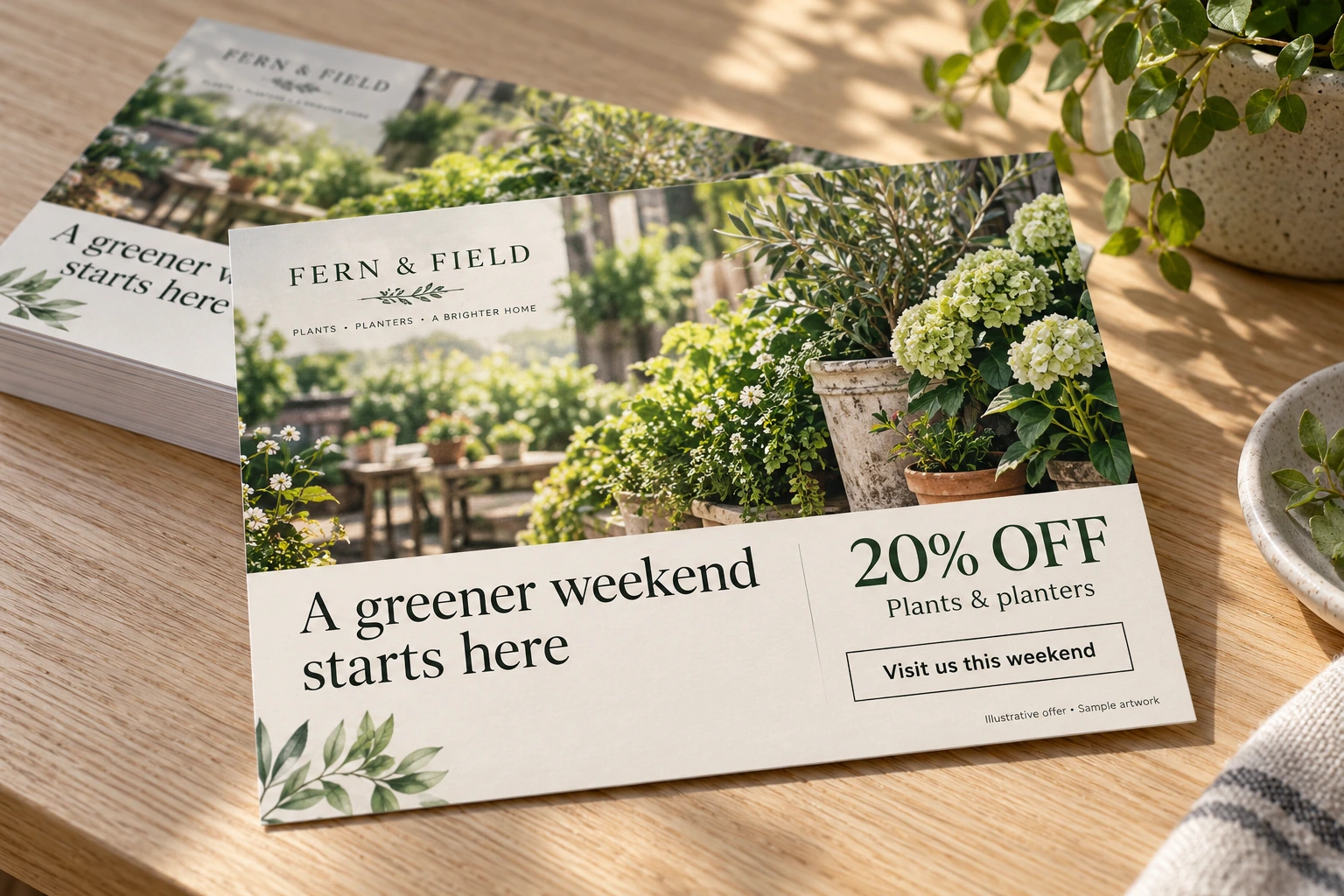
Give the piece one primary action. State what is available, who it is for, why it is useful and how to respond. A phone number and readable web address provide alternatives to a QR code. Keep offer restrictions close enough to the offer that customers can understand the deal without hunting through the layout.
Print a full-size proof and hand it to someone who has not worked on the project. Ask what the business offers and what they would do next. Their answer is a practical clarity check, not a measured prediction of campaign performance. Test the destination page and contact process on a phone before approval.
Work backward from contribution, not sales revenue
Here is a hypothetical 2,000-piece campaign. USPS listed EDDM Retail postage at $0.26 per piece when checked on October 11, 2026. Recheck the current price in the USPS campaign tool and guidance before purchase. Every other amount below is an illustrative assumption, not a supplier quote.
- Postage: 2,000 × $0.26 = $520
- Printing: $700
- Design and preparation: $280
- Total campaign cost: $1,500, or $0.75 per mailed piece
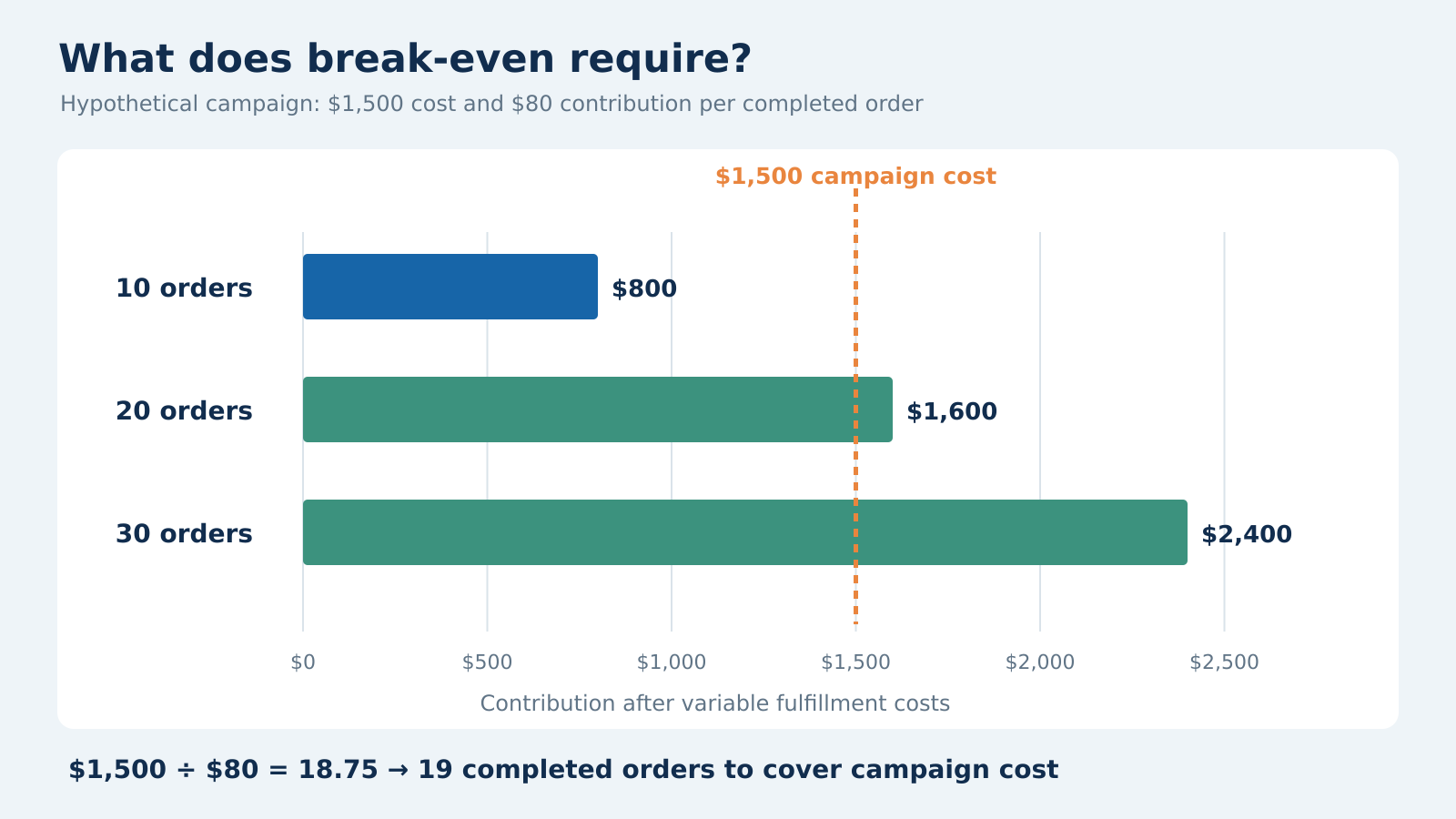
Suppose each completed order contributes $80 after the offer discount and variable fulfillment costs. Divide $1,500 by $80: the campaign needs 18.75 orders, rounded up to 19, to cover its campaign cost. That is 0.95% of mailed pieces becoming completed orders. It is a break-even requirement, not an expected conversion rate.
If 40 people inquire and half buy, 20 orders contribute $1,600. The remaining $100 is before fixed overhead and any omitted costs. With only 20 inquiries and the same close rate, 10 orders contribute $800, leaving a $700 shortfall. Include taxes, delivery, extra labor and other actual costs in your own model; count repeat business only when supported.
Prepare the handoff and close the learning loop
Use the order’s current paperwork and specified entry location. USPS requires route-separated bundles of 50–100 pieces with a facing slip and piece count; follow the current mail-preparation instructions rather than reusing an old job’s paperwork. Keep one approved sample and a record of the actual mailing cost.
Before mailing, decide how staff will record inquiries, completed orders and contribution. A campaign identifier can connect phone and counter responses to the same test. For digital measurement, use our GA4, UTM and QR-code guide. Review the campaign after a response window suited to the offer, acknowledge unattributed orders, and change one major variable at a time. The next mailing should follow evidence from this one.