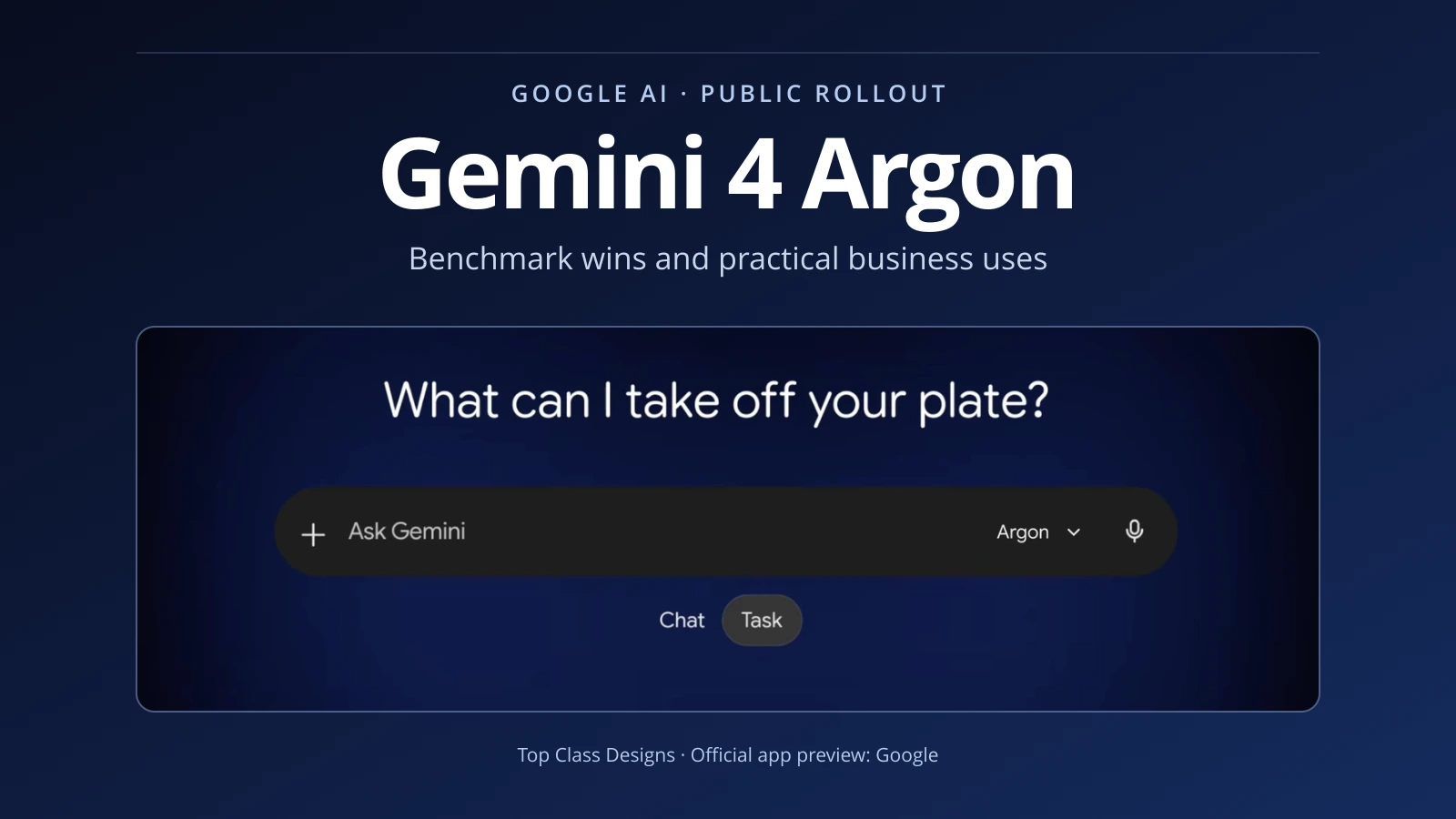
Gemini 4 Argon reaches a broader audience with strong independent benchmark results and promising business uses. Google’s October 13 public rollout gives small creative teams a chance to explore those strengths in proposal writing, research, marketing operations and website work.
Google first announced Argon on September 30 for trusted cybersecurity defenders. The October 13 expansion brings paid API access and a rollout to eligible Gemini app subscribers.
Scores and availability checked October 13, 2026. This is a source-based analysis; Top Class has not independently tested Argon.
What makes Gemini 4 Argon worth a look?
Independent leaderboards show real strengths
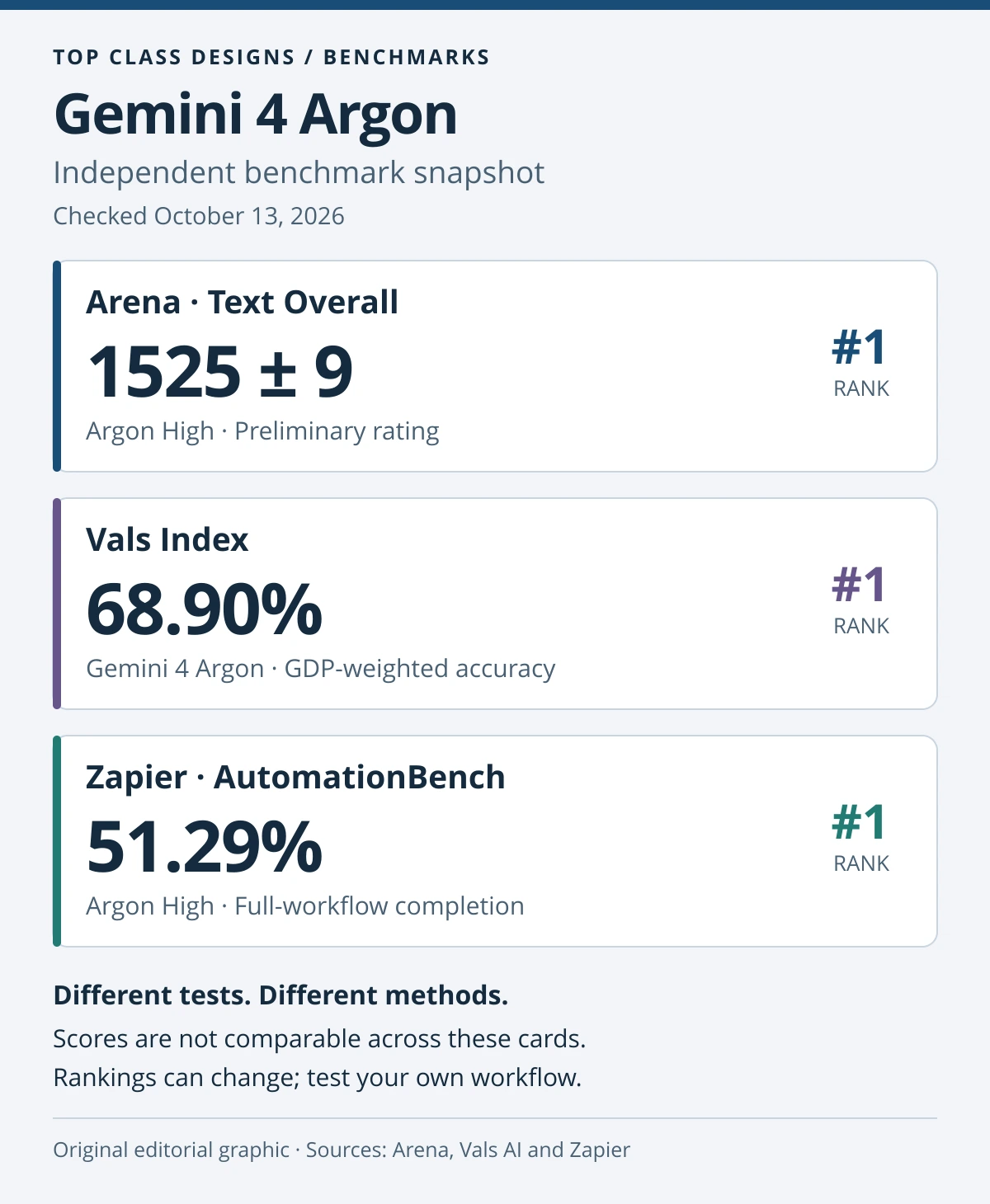
- Text Arena: Argon High ranks No. 1 at 1525 ± 9, a preliminary result. For client-facing drafts and explanations, that preference signal makes Argon worth testing. Arena uses anonymous head-to-head votes; the rating measures preference, not percentage accuracy.
- No. 1 on the Vals Index: the benchmark operator reports 68.90%, versus 67.04% for runner-up Claude Sonnet 5.5 and 66.97% for Opus 5.5. Its GDP-weighted index covers finance, coding, legal and tax work. That broader reasoning evidence matters when a proposal requires connecting facts across several documents.
- No. 1 on AutomationBench: Zapier’s current board gives Argon High 51.29% overall and 58.0% in marketing. The benchmark checks whether simulated business apps end in the correct state. That makes it relevant to campaign handoffs spanning records, spreadsheets and messages. These are completion rates, not productivity gains.
Results vary by task: Argon High is No. 9 on WebDev Arena. Test the work you plan to delegate.
Longer reasoning and mixed-source work
Google’s model card reports 77.9% on DeepSWE v1.1, versus 74.2% for Claude Opus 5.5 and 74.1% for GPT-6 Astra in its comparison. These vendor-reported coding results suggest promise for website maintenance and internal tools. The card also lists text, image, audio and video inputs with text output, making analysis of mixed project material a relevant use to explore.
The API’s 1,048,576-token window is shared by input, thinking and output. Think of it as one working space for your source material, the model’s reasoning and its answer. For a creative team, the opportunity is to work through a substantial brief and its supporting material, then produce coherent writing or code. Final artwork still needs normal production checks.
Three useful trials for a creative business
Translate those strengths into a small, measurable trial using approved sample material.
Turn a scattered brief into a proposal outline
Supply a sample brief, scope and brand notes. Ask for a proposal outline and missing information. Check quantities, deliverables and deadlines. A useful result should save assembly time while keeping pricing and client commitments under human approval.
Check a print or sign job’s intake information
Give it a request missing dimensions, material or installation details. Ask which questions matter before quoting. Score omissions caught and facts invented. Keep final checks for bleed, fonts, color, scale and production paths, plus proof approval, in the normal workflow.
Build a useful website feature
Try a quote-enquiry form on a staging site. Supply required fields and example requests, then check validation, mobile layout and where submissions go. Count debugging and review time alongside coding time before deciding whether it helps your team.
Who can use Gemini 4 Argon now?
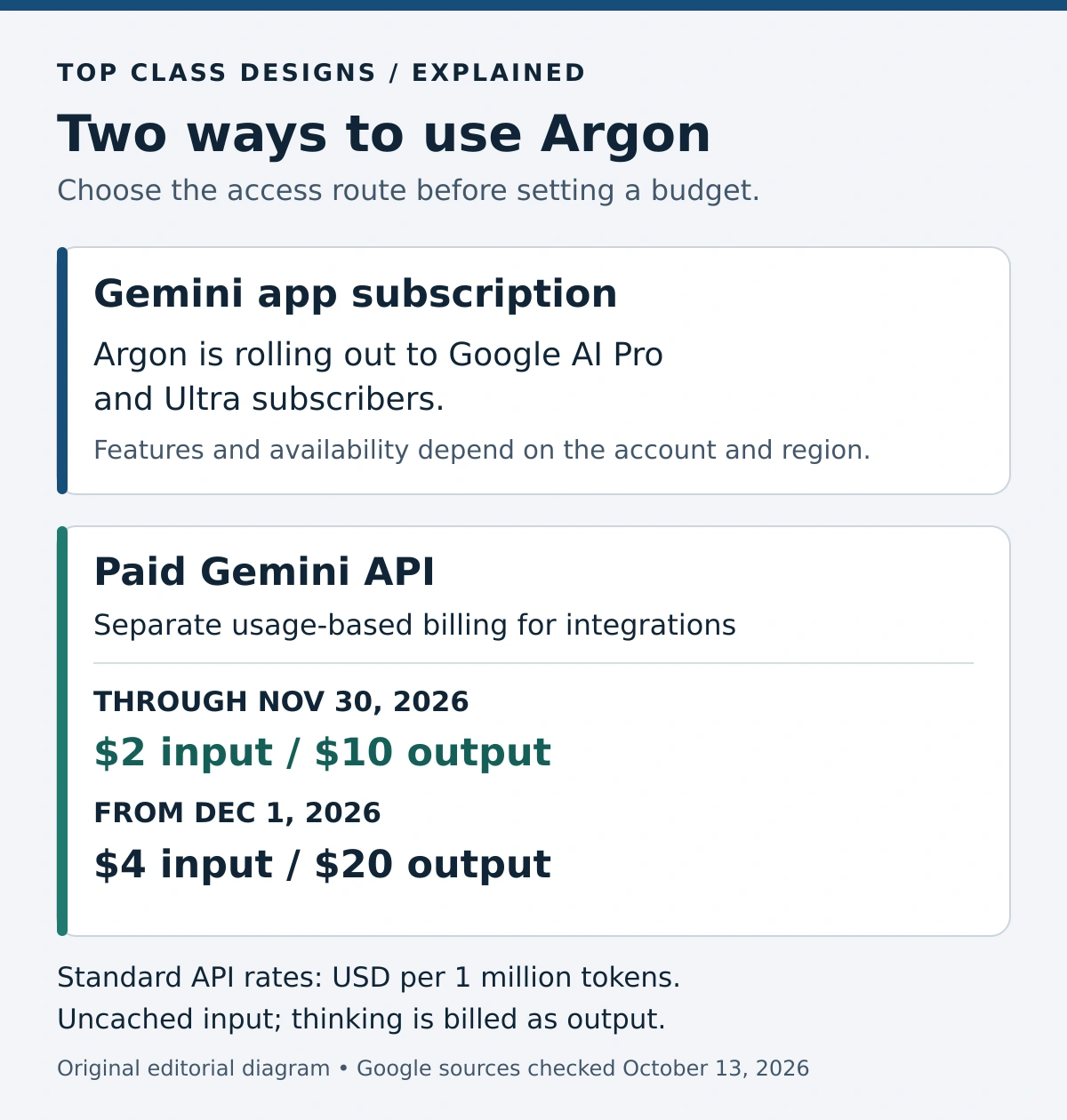
- Gemini app and AI Mode in Search: Google says Argon is rolling out to Google AI Pro and Ultra subscribers, subject to product and regional availability.
- Gemini API: developers can access Argon on the paid tier. Budget API usage separately from a consumer app subscription.
- AI Studio and Antigravity: Google’s October 13 developer announcement names Ultra as the subscription route.
For coding users, the Google AI plans page also lists Argon in Antigravity under Pro, while the dated launch posts specify Ultra. Confirm your entitlement and local price before buying a plan for that purpose.
Tasks have additional restrictions
The app update puts a Chat/Task toggle in the main conversation window and brings Antigravity’s coding interface into Gemini for macOS. Gemini also supports more than 40 connected apps, including Adobe and Shopify.
Google’s Tasks help requires a personal Google Account, age 18 or older, Pro or Ultra, Keep Activity enabled and a Personal Intelligence opt-in. Work and school accounts are currently excluded. Tasks are also unavailable in the EEA, United Kingdom, Switzerland and Nigeria. These restrictions apply to Tasks, rather than Argon generally.
Local Chrome tasks need the computer awake; Google’s cloud browser can continue after you close it. Check progress for requests needing your input.
API pricing changes after November 30
Google’s standard API pricing lists these Argon rates in US dollars, per million tokens:
- Through November 30, 2026: $2 for input and $10 for output.
- From December 1, 2026: $4 for input and $20 for output.
The API documentation says thinking tokens are billed as output. Eligible cached input receives a lower rate. A short final answer can therefore cost more than its visible length suggests.
For example, 100,000 uncached input tokens plus 10,000 billed output tokens would cost $0.30 during the introductory period, then $0.60 at the published December rates. Those are token-only calculations, not prices for a completed job. Include every call and thinking token when measuring a workflow, along with any separate tool charges.
Our Muse Wonder access and pricing guide covers another recent release. Compare completed-task cost and correction time before choosing a tool.
Check connections before delegating work
Google’s privacy guidance says Tasks may use connected folders, apps and signed-in website content, and share information with other services to complete work. Disconnecting an app does not erase information it already received.
Connect only the sources needed, review permissions and approve external messages or live-site changes. Measure the entire job, including corrections and review. Argon’s strong results make it a serious candidate to test; the deciding factor is the useful work your team can approve.
Featured editorial layout and diagrams: Top Class Designs. Official Gemini interface preview: Google.