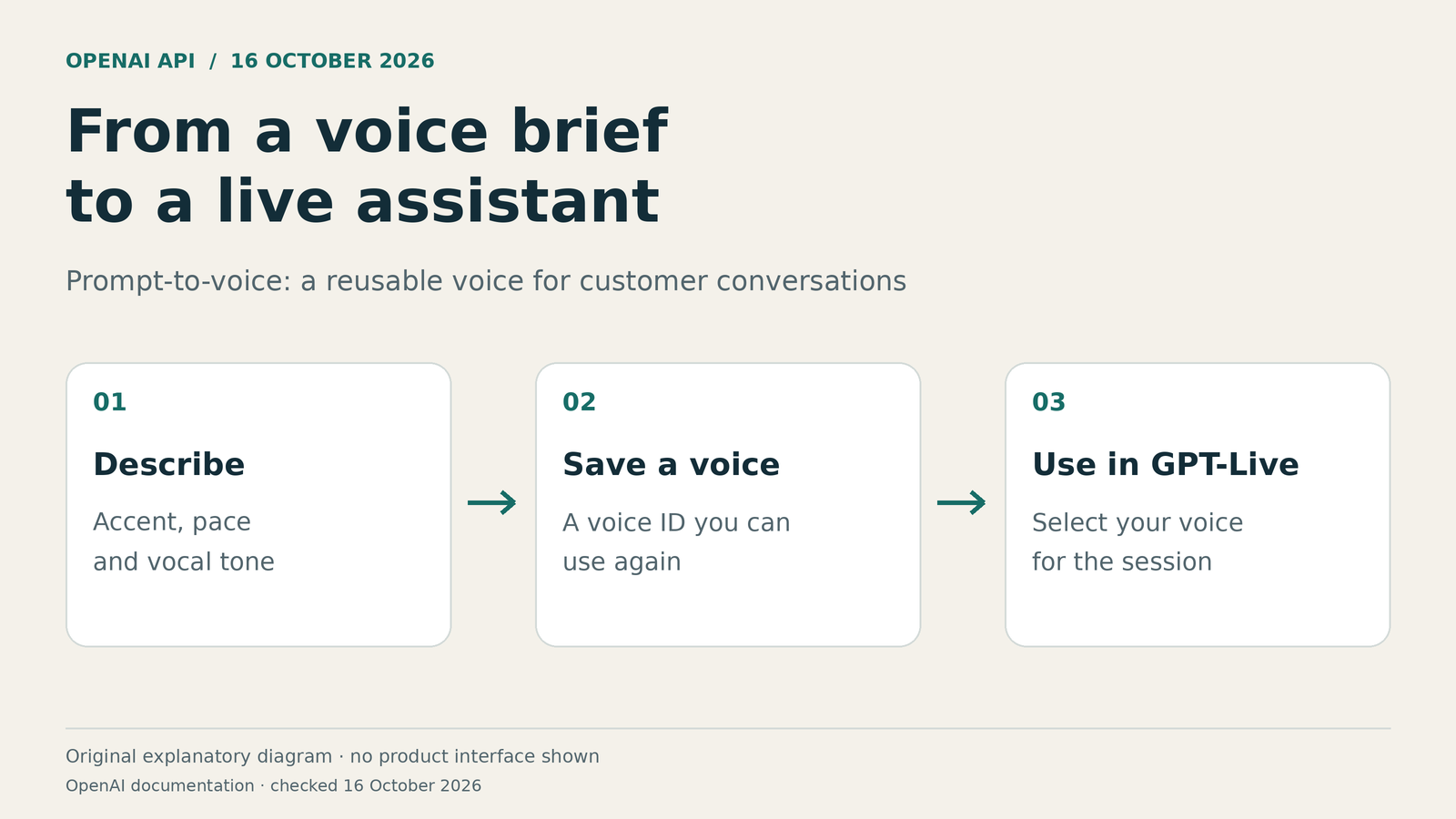
OpenAI prompt-to-voice is now available to all API customers. The October 16, 2026 release announcement lets developers create reusable GPT-Live voices from written descriptions through the API or voice Playground. It also adds nine natural voices across German, French, Hindi, Japanese and Korean.
For a small business building a customer assistant, this creates another brand decision: how should the service sound? A print shop might want a calm, clear voice that can explain a proof deadline without sounding hurried. A distinctive voice is useful only if customers can understand the information it delivers.
Start with a practical voice brief
Write a short description of the delivery you want. For example: “A warm adult voice with a clear American English accent, moderate pace and steady delivery, suitable for explaining print orders.” That is an illustrative brief, not a tested preset.
Keep the voice brief separate from your business rules. Deciding how an assistant sounds does not establish what it may promise about turnaround, pricing or refunds. As in our guide to giving AI clear, reviewable creative work, define the task and approval points before handing over a customer-facing process.
Check compatibility before building
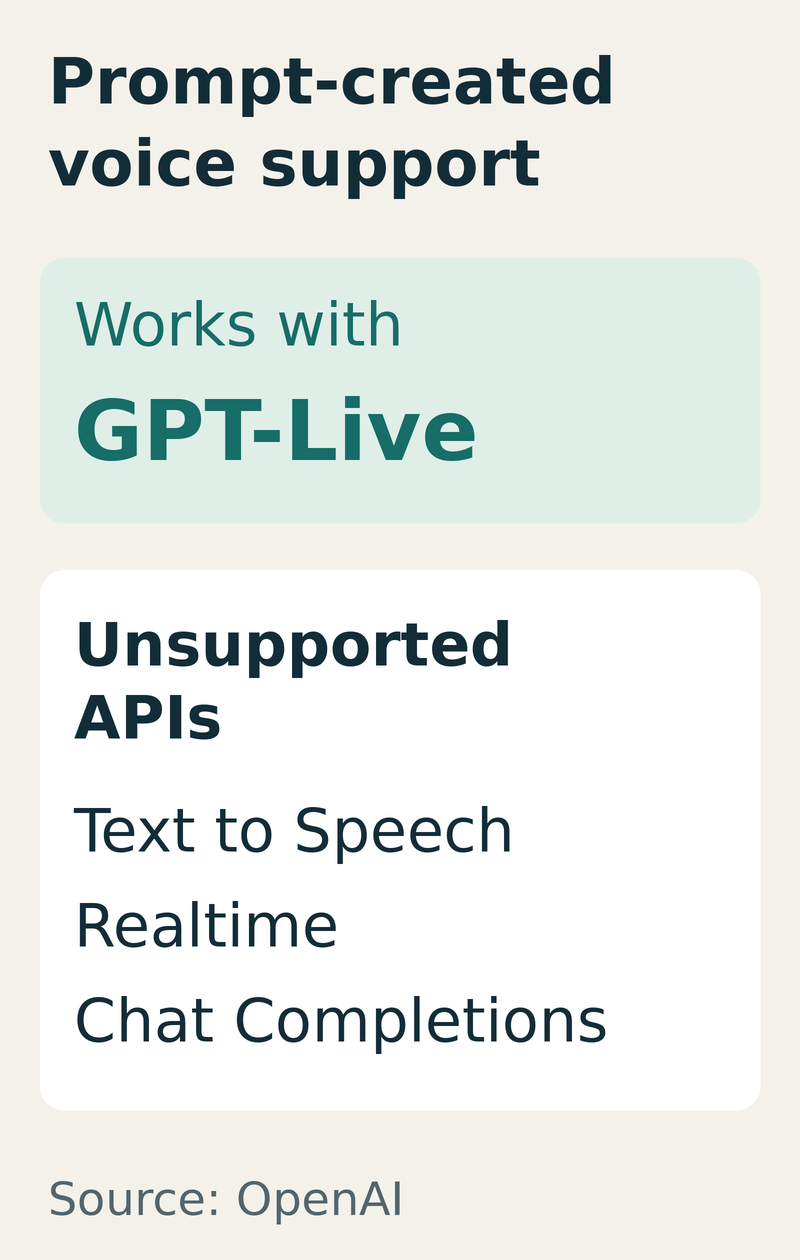
OpenAI’s documentation limits prompt-generated voices to GPT-Live and 100 per organization. Text to Speech, Realtime and Chat Completions APIs are unsupported. Voices are not guaranteed unique.
Recording-based voices remain a separate, restricted service requiring a speaker’s consent and matching sample. Text-based creation needs neither recording.
Free creation still has running costs
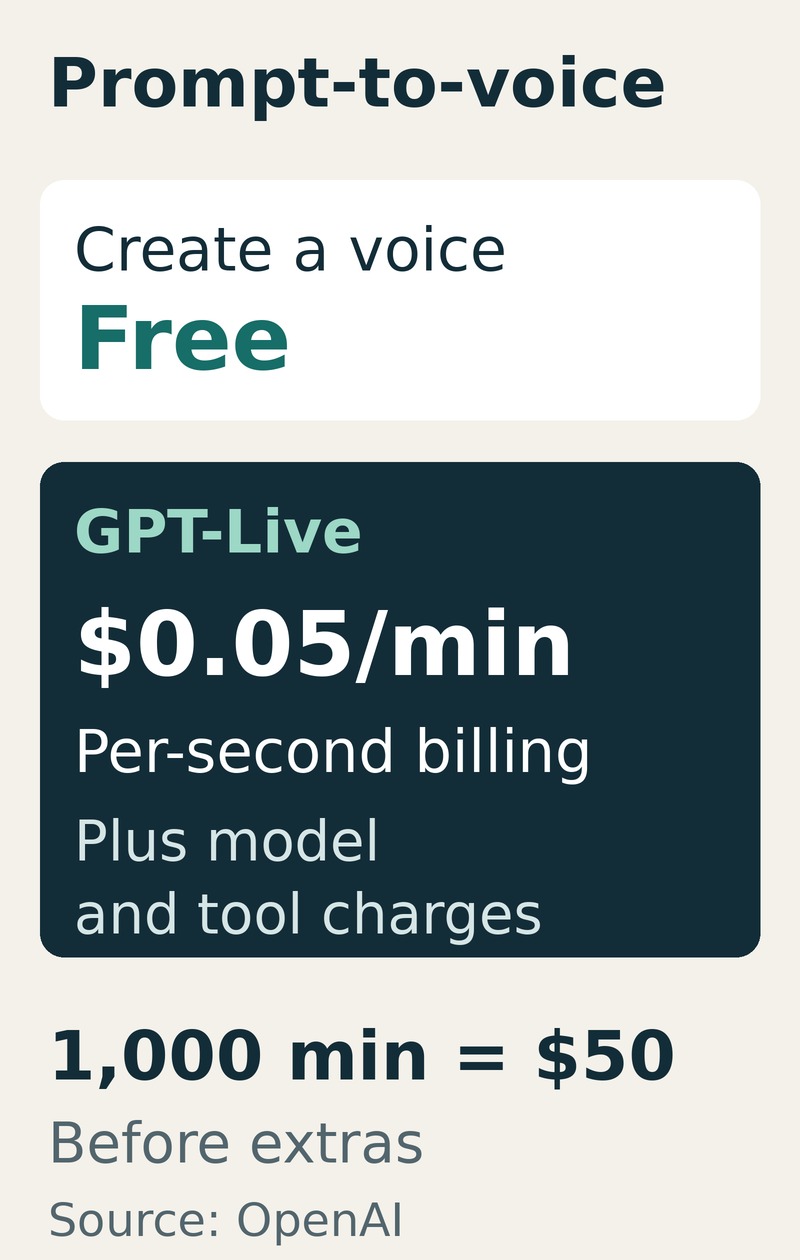
Creating a prompt-generated voice is free. OpenAI’s pricing page lists GPT-Live at $0.05 per minute, billed by the second without rounding up. Backend model and tool use cost extra. Auditioning the voice in the Playground also runs a billed session.
For planning, 1,000 session minutes would therefore cost $50 before those additional charges. That is arithmetic from the published rate, not a quote for a complete assistant. Include testing and the actual length of customer conversations in your estimate.
Review the safeguards
Use adult voices, avoid imitating named people or fictional characters, and disclose AI-generated speech. Preserve provenance indicators. Voice creation is incompatible with Zero Data Retention; eligible GPT-Live speech generation can use it.
Before launch, test names, order numbers, corrections and requests for a human with approved sample information. Compare intelligibility and successful handoffs alongside the sound of the voice. A polished delivery should make the service easier to use.
Sources checked October 16, 2026. Source-based analysis; no hands-on performance claims. Diagrams are original explanatory artwork, not OpenAI interface screenshots.